skip to main content

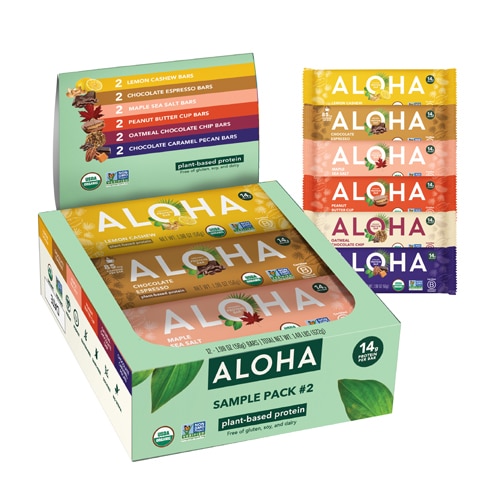
Aloha Organic Plant Based Protein Bars - Sampler Pack #2 -- 12 Bars


Aloha Organic Plant Based Protein Bars - Sampler Pack #2
  • Our price: $38.99

  • +

Added to My List as a guest.

Your guest list will be saved temporarily during your shopping session.

Sign in to add items to your saved list(s).

1 item added to your list

Aloha Organic Plant Based Protein Bars - Sampler Pack #2 -- 12 Bars

Oops! Something went wrong and we were unable to process your request. Please try again.

Use code Code ULTIMAFREE to receive free gift with $25 purchase Ends: 12/29/25 at 7:00 a.m. ET

  • Guaranteed Authentic

    100% Authentic

    • ✓ Products sourced directly from brands or authorized distributors
    • ✓ No third-party resellers
    • ✓ Products stored and shipped in conditions that ensure quality
    • ✓ Vitacost is 100% committed to your well-being and safety
  • Non-GMO Project Verified
  • Certified B Corporation

Aloha Organic Plant Based Protein Bars - Sampler Pack #2 Description

  • Aloha Organic Protein Bars
  • Whole Food Ingredients
  • 14 g Protein Per Bar
  • Plant-Based Protein
  • Non GMO Project Verified
  • USDA Organic
  • Free of Gluten, Soy, and Dairy
  • Certified Vegan
  • No Stevia
  • Kosher

Aloha Sample Pack #2 Contains:


2 Lemon Cashew Bars

2 Chocolate Espresso Bars

2 Maple Sea Salt Bars

2 Peanut Butter Cup Bars

2 Oatmeal Chocolate Chip Bars

2 Chocolate Caramel Pecan Bars


We're Aloha

We're here to support your journey to a happier, healthier life, every day. That's why we make deliciously satisfying food using ethically-soruced, organic ingredients that are good for you and the planet. As a Certified B Corp, we're all about balancing purpose and profit while caring for the communities that nurture us. That's the Aloha Way.


Don't just take our word for it - give it a try. If for any reason you're unsatisfied, we'll make it right.

Free Of
( Version -1):
GMOs, animal ingredients, gluten, dairy, soy, and stevia. ( Version -1):
GMOs, animal ingredients, gluten, dairy, soy, and stevia.

*These statements have not been evaluated by the Food and Drug Administration. This product is not intended to diagnose, treat, cure, or prevent any disease.


Nutrition Facts for Version -1
Nutrition Facts
Serving Size: 1 Bar (56 g)
Servings per Container: 12
Amount Per Serving% Daily Value
Lemon Cashew Protein Bar
Calories230
Total Fat10 g13%
   Saturated Fat3.5 g18%
   Trans Fat0 g
   Polyunsaturated Fat1 g
   Monounsaturated Fat4 g
Cholesterol0 mg0%
Sodium120 mg5%
Total Carbohydrate26 g9%
   Dietary Fiber9 g32%
   Total Sugars5 g
     Includes Added Sugars4 g8%
Protein14 g16%
Vitamin D0 mcg0%
Calcium25 mg2%
Iron3 mg15%
Potassium127 mg2%
Other Ingredients: Protein blend* (brown rice protein*, pumpkin seed protein*), tapioca fiber*, cashew butter* (roasted cashews*, high oleic sunflower oil*), cashews*, tapioca syrup*, coconut flakes*, brown sugar*, vegetable glycerin*, brown rice crisps* (brown rice*, brown rice syrup*, salt), natural lemon flavor*, vanilla extract*, sea salt. *Organic Contains: tree nuts (cashews)

Nutrition Facts for Version -1
Nutrition Facts
Serving Size: 1 Bar (56 g)
Servings per Container: 12
Amount Per Serving% Daily Value
Maple Sea Salt Protein Bar
Calories220
Total Fat9 g12%
   Saturated Fat1 g5%
Trans Fat
   Polyunsaturated Fat3.5 g
   Monosaturated fat2.5 g
Cholesterol0 mg0%
Sodium130 mg6%
Total Carbohydrate26 g9%
   Dietary Fiber10 g36%
   Total Sugars4 g
     Includes Added Sugars4 g6%
Protein14 g17%
Vitamin D0 mcg0%
Calcium39 mg4%
Iron6 mg35%
Potassium107 mg2%
Other Ingredients: Protein blend* (brown rice protein, pumpkin seed protein*), tapioca fiber*, sunflower butter* (roasted sunflower seeds*, high oleic sunflower oil*), tapioca syrup*, rolled oats*, vegetable glycerin*, brown sugar*, almond butter*, pecans*, maple syrup*, natural flavor*, sea salt. *Organic

Contains: tree nuts (almonds and pecans)


Nutrition Facts for Version -1
Nutrition Facts
Serving Size: 1 Bar (56 g)
Servings per Container: 12
Amount Per Serving% Daily Value
Chocolate Espresso Protein Bar
Calories230
Total Fat10 g13%
   Saturated Fat2.5 g13%
   Trans Fat0 g
   Polyunsaturated Fat3.5 g
   Monosaturated fat2 g
Cholesterol0 mg0%
Sodium70 mg3%
Total Carbohydrate26 g9%
   Dietary Fiber10 g36%
   Total Sugars5 g
     Includes Added Sugars4 g8%
Protein14 g15%
Vitamin D0 mcg0%
Calcium36 mg2%
Iron2 mg10%
Potassium201 mg4%
Other Ingredients: Protein blend* (brown rice protein*, pumpkin seed protein*), sunflower butter* (roasted sunflower seeds*, high oleic sunflower oil*), tapioca fiber*, tapioca syrup*, vegetable glycerin*, chocolate chips* (chocolate*, cane sugar*, cocoa butter*, vanilla extract*), cocoa powder*, cocoa nibs*, brown sugar*, ground coffee*, coffee extract*, natural flavor*, sea salt, monk fruit*. *Organic

Nutrition Facts for Version -1
Nutrition Facts
Serving Size: 1 Bar (56 g)
Servings per Container: 12
Amount Per Serving% Daily Value
Peanut Butter Cup Protein Bar
Calories230
Total Fat10 g13%
   Saturated Fat3 g15%
   Trans Fat0 g
   Polyunsaturated Fat1 g
   Monounsaturated Fat6 g
Cholesterol0 mg0%
Sodium135 mg6%
Total Carbohydrate26 g9%
   Dietary Fiber10 g36%
   Total Sugars5 g
     Includesw Added Sugars4 g8%
Protein14 g17%
Vitamin D0 mcg0%
Calcium26 mg2%
Iodide1 mg6%
Iron124 mg2%
Potassium
Other Ingredients: Peanuts*, tapioca fiber*, protein blend* (brown rice protein*, pumpkin seed protein*), dark chocolate* (chocolate*, cane sugar*, cocoa butter*), tapioca syrup*, vegetable glycerin*, sea salt, monk fruit*, sunflower lecithin*. *Organic

Contains: peanuts

Manufactured in a facility that also processes egg, fish, milk, peanuts, sesame, soy, tree nuts, and wheat.


Nutrition Facts for Version -1
Nutrition Facts
Serving Size: 1 Bar (56 g)
Servings per Container: 12
Amount Per Serving% Daily Value
Oatmeal Chocolate Chip Protein Bar
Calories220
Total Fat8 g10%
   Saturated Fat2 g10%
   Trans Fatg
   Polyunsaturated Fat3 g
   Monounsaturated Fat2.5 g
Cholesterol0 mg0%
Sodium160 mg7%
Total Carbohydrate27 g10%
   Dietary Fiber10 g36%
   Total Sugars4 g
     Includes Added Sugars4 g8%
Protein14 g18%
Vitamin D0 mcg0%
Calcium33 mg2%
Iron6 mg35%
Potassium100 mg2%
Other Ingredients: Protein blend* (brown rice protein*, pumpkin seed protein*), tapioca fiber*, sunflower butter* (roasted sunflower seeds*, high oleic sunflower oil*), chocolate chips* (chocolate*, cane sugar*, cocoa butter*, vanilla extract*), tapioca syrup*, rolled oats*, vegetable glycerin*, brown sugar*, brown rice crisps* (brown rice*, brown rice syrup*,salt), natural flavor*, sea salt, sunflower lecithin*, vanilla extract*. *Organic

Manufactured in a facility that also processes egg, fish, milk, peanuts, sesame, soy, tree nuts, and wheat.


Nutrition Facts for Version -1
Nutrition Facts
Serving Size: 1 Bar (56 g)
Servings per Container: 12
Amount Per Serving% Daily Value
Chocolate Caramel Pecan Protein Bar
Calories230
Total Fat11 g14%
   Saturated Fat2.5 g13%
   Trans Fatg
   Polyunsaturated Fat3.5 g
   Monounsaturated Fat3 g
Cholesterol0 mg0%
Sodium140 mg6%
Total Carbohydrate24 g9%
   Dietary Fiber10 g36%
   Total Sugars5 g
     Includes Added Sugars4 g8%
Protein14 g17%
Vitamin D0 mcg0%
Calcium36 mg2%
Iron6 mg35%
Potassium118 mg2%
Other Ingredients: Protein blend* (brown rice protein*, pumpkin seed protein*), tapioca fiber*, sunflower butter* (roasted sunflower seeds*, high oleic sunflower oil*), dark chocolate* (chocolate*, cane sugar*, cocoa butter*), tapioca syrup*, vegetable glycerin*, pecans*, brown rice crisps* (brown rice*, brown rice syrup*, salt), caramel*, natural flavor*, sea salt, sunflower lecithin*. *Organic

Contains: tree nuts (pecans)

Manufactured in a facility that also processes egg, fish, milk, peanuts, sesame, soy, tree nuts, and wheat.

The product you receive may contain additional details or differ from what is shown on this page, or the product may have additional information revealed by partially peeling back the label. We recommend you reference the complete information included with your product before consumption and do not rely solely on the details shown on this page. For more information, please see our full disclaimer.
View printable version Print Page

One Fuels the Long Haul, the Other Fires the Sprint: Understanding Endurance and Stamina

[vc_row][vc_column][vc_column_text]When people talk about fitness performance, the terms stamina and endurance are often used interchangeably. While these two concepts do share a few similarities, they also have important distinctions and serve their own specific functions in your workout routine. Let’s explore the main differences between stamina and endurance, along with actionable steps to cultivate both in a way that honors and aligns with your wellness needs.

A Man Sprints on a Track, Representing Endurance vs Stamina.

What Is Endurance?

Starting with endurance, Frontiers in Physiology refers to endurance as the body’s metabolic, cardiovascular and muscular capacity to both economize and sustain movement for a prolonged amount of time. In other words, endurance is all about duration; how long you’re able to consistently perform an action, from hiking a trail to running a half-marathon, before fatigue sets in. Endurance allows the heart and lungs to circulate oxygen, the muscles to exert repetitive contractions and the metabolism to convert fuel into energy. All of these processes lead to functional gains in aerobic capacity. What does this mean for your fitness routine? In practical terms, if you start walking for 20 minutes five times a week, then gradually increase to 45 minutes, this reflects an endurance boost. Your body is learning how to sustain continual muscle repetition and efficient oxygen uptake, which allows you to exercise longer and cover more distance.

What Is Stamina?

On the other hand, stamina is the ability to maintain a high level of performance at a rigorous intensity. Frontiers in Sports and Active Living defines stamina as training your muscle fibers to rapidly consume energetic reserves and put forth the maximum amount of effort, while learning how to push beyond the onset and limits of fatigue. In other words, teaching your muscles to use energy quickly and work as hard as possible, even when you start to feel tired. Stamina requires both physical tolerance and mental resilience. This combination helps you withstand exhaustion, so you can keep moving with power and precision, even as the muscles start to tire out. Think of that final explosive burst you muster at the end of a workout to achieve the time or distance you’re aiming for. This is stamina. High-intensity interval training (HIIT) is ideal for increasing stamina. HIIT circuits activate the body’s aerobic (slow-twitch muscle) and anaerobic (fast-twitch muscle) capacity to increase strength resistance and cardiorespiratory fitness. Meanwhile, these exercises can also regulate cortisol to calm the nervous system and make the brain more adaptive to stress.

The Difference Between Endurance and Stamina

If endurance is the engine that spurs you on to continue moving at a steady, consistent pace, then stamina is the ignition fuel that enables you to press hard, recover and then repeat. For example, a soccer player who relies on short bursts of speed to switch directions, execute precise moves and outrun competitors is using stamina. Whereas a long-distance cyclist who maintains the same repetitive motion for hours is using endurance. There’s some overlap between stamina and endurance, but the primary distinction between them can be summed up in the following way:
  • Endurance: The duration of which you can sustain a consistent, repetitive action before muscular fatigue sets in.
  • Stamina: The intensity level at which you can perform while resisting the physical and mental effects of fatigue.

How to Increase Both Endurance and Stamina

As with introducing any fitness component to your exercise routine, it’s important to remember each body is unique. Check in with the signals your own body communicates and honor what it needs with intentional adjustments to account for soreness, discomfort, restrictions or dips in energy and performance. The Sports Journal suggests that moderate, progressive load increases are most sustainable for building stamina and endurance, so take it steady at first, then escalate the workout duration and intensity over time. Here’s how to get started.

Establish a goal and track how it feels.

Think about your current fitness levels. Can you walk at a fast pace for 20 minutes before tiring out? Can you perform 20 squats with 10-pound weights before your muscles feel spent? Now consider how your body reacts after exercise. Is the recovery quick and smooth or do you still notice soreness and fatigue the next day? This information reflects the baseline of where your endurance and stamina are right now. From there, you can determine a goal of how much you want them to increase. For example: “I will walk at a fast pace for 45 minutes,” or “I will perform 50 squats with 10-pound weights.” As you build to this objective, track the physical and mental sensations that come with it, then based on what your body communicates, either scale up or ease back.

Cultivate a foundation of consistency.

Aim for three to four sessions of aerobic movement per week, whether it’s cycling, swimming, running or walking. Start at your baseline (I.E., 20 minutes), then steadily increase the duration until you reach the established goal (I.E., 45 minutes). Frontiers in Physiology found that a consistent 12-week endurance program will boost various functional mechanics like speed, gait, aerobic capacity and oxygen uptake, all of which make it easier to sustain physical exertion at a pace that feels comfortable.

Focus on gradual boosts of intensity.

Once your endurance levels noticeably increase (I.E., you can sustain a consistent, moderate effort for a prolonged amount of time), introduce higher-intensity elements. For example, build faster intervals into your walking routine. Start with an easy pace for 3-5 minutes, then accelerate to a brisk pace for just 1 minute and continue this repetition for about 5–10 cycles. Over time, aim for one minute of sprinting. Research indicates that quick bursts of intensity at maximum effort lead to more efficient aerobic and anaerobic economy.

Incrementally blend the two together.

A typical week of building endurance and stamina might look like having two endurance sessions with 30–45 minutes of steady-state cardio exercise and two stamina sessions with 20 minutes of short HIIT and rest intervals. Make sure to build in at least one day of gentle movement, too. Stretching, walking or yoga, for instance, gives your body the rest it needs between sessions. Set aside time after each session to track your mental and physical sensations as well as your performance metrics. Over time, you’ll notice recurring patterns in terms of how much exertion your body can tolerate and how efficiently it can recover.

Build Endurance and Stamina to Reach Your Fitness Goals

Endurance is the reliable engine that allows you to cover long distances and stretches of time, while stamina is the power reserve that fuels you to maintain rigorous levels of intensity. Both are important and beneficial for overall fitness, but the key is to focus on incremental growth in your physical and mental capacity. Remember: this isn’t about forcing yourself to push toward maximum effort all the time. It’s about starting where you are and scaling up gradually, based on what’s right for your body and abilities. This is how you achieve sustainable outcomes that make your mind and body feel good![/vc_column_text][/vc_column][/vc_row][vc_row][vc_column][vc_text_separator title="Featured Products" border_width="2"][vc_row_inner][vc_column_inner width="2/12"][/vc_column_inner][vc_column_inner width="3/12"][vc_single_image image="189799" img_size="full" onclick="custom_link" img_link_target="_blank" css="" link="https://www.vitacost.com/legion-athletics-recharge-post-workout"][/vc_column_inner][vc_column_inner width="2/12"][/vc_column_inner][vc_column_inner width="3/12"][vc_single_image image="189797" img_size="full" onclick="custom_link" img_link_target="_blank" css="" link="https://www.vitacost.com/aloha-organic-plant-based-protein-bars-sampler-pack-2"][/vc_column_inner][vc_column_inner width="2/12"][/vc_column_inner][/vc_row_inner][/vc_column][/vc_row]

Please enter a valid zip code
FLDC15