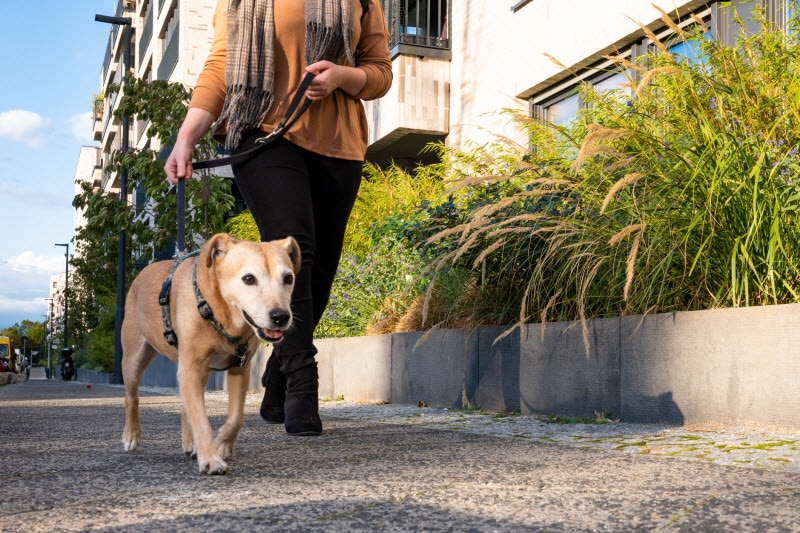
[vc_row][vc_column][vc_column_text]The walks you enjoy with your pup will work wonders for your well-being, but they could be a source of discomfort for your pet if there are issues with their joint health.
None of us wants to see our four-legged friends struggle, stagger or strain, but as dogs get older, they will inevitably accumulate wear and tear in their joints, cartilage and tendons. A lifetime of chasing sticks, tearing around in circles and leaping through lawn sprinkler streams eventually takes its toll. In fact, the American Kennel Club estimates that
one in four dogs suffers to some degree from declining joint health due to arthritis. So if your dog has entered his senior years, it’s important to be aware of the subtle signs that he’s struggling with pain and lack of mobility.
Luckily, there are remedies you can apply to ease discomfort, and preventive measures to prolong optimal joint health for as long as possible.
What causes poor joint health in dogs?
For the most part, a dog’s joint health degenerates as it ages because the protective cartilage wears away where the ball and socket connect. In
senior dogs, that causes stiffness, impairs mobility and leads to soreness. From around eight years onwards, dogs are more likely to start showing signs of canine arthritis, with inflamed joints that cause pain as the bones grind together.
However, younger dogs can be affected too. Many smaller or “toy breeds,” for example, are vulnerable to
patella luxation, or slipping knees, and the condition can manifest itself after just a year or so. It’s a genetic condition that causes dogs to “skip” or “hop” as the kneecap pops out of place, and, according to
The Kennel Club, you’ll commonly see it in these breeds:
- King Charles Spaniel
- Chihuahua
- Jack Russell Terrier
- Pugs and more.
Older dogs are also prone to
hip dysplasia, an inherited deformity where the hip joints become loose and unstable. Some breeds are more vulnerable than others. Hip dysplasia is most common in large, heavy dog breeds, such as:
- Great Danes
- Rottweilers
- Saint Bernards
- Newfoundlands
- Golden and Labrador retrievers
- German shepherds
However, the condition can develop from almost any age in a dog that is overweight, and it’s why you should maintain a lean, normal weight for your pup during the early years while bones and joints are still growing.
Dr. Glen Romney of the
Animal Hospital of Saint Maarten sees a lot of cases where big dogs develop early hip dysplasia from standing up on the hind legs to greet their owner. “Whenever you have the weight of the dog misdistributed, that causes stress on the hips,” he says.
Over- or under-exercising your pet during the formative years can also lead to premature hip dysplasia. Some owners underestimate how active their breed is and can’t keep up with their required exercise routine, while others submit their excitable pup to hikes or extended runs that are beyond its capability.
Not sure where the sweet spot lies? It’s important to understand
how much exercise a dog really needs.
Symptoms of joint disease in dogs
Pets can’t directly communicate the source of their pain, so it’s easy to confuse some of the symptoms of joint disease — loss of appetite, fatigue, irritability — with something else.
However, there are some patterns and behaviors that should set the joint health alarm bells ringing:
- Slowness and clumsiness when getting up or lying down
- Limping
- Falling or slipping
- Difficulty going up the stairs or hopping in and out of the car
One of the most heart-wrenching elements of looking after a pet with joint disease is that your pup is primed to please and play. Sometimes he just can’t help himself, and he’ll “leap” into action with customary enthusiasm only to suffer the consequences later.
That’s why, at the first suspicion that your dog’s joint health isn’t what it used to be, you should slow down the pace of your play together, get them to a vet, and crank up your regular supplement routine. There’s still plenty you can do.
How to prevent and manage dog joint pain
If your dog is suffering from advanced arthritis or hip dysplasia, then surgery and hip replacement may be required. However, if you catch the condition early enough, there may be non-surgical interventions to slow down or suspend the onset of symptoms.
As a general guide, the
American Kennel Club recommends:
- Regular veterinary visits (twice a year for senior dogs)
- Watching your pet’s weight and cutting back on treats if your furball’s coat is starting to look a size or two too tight
- Exercising gently but regularly
- Placing pet ramps or dog stairs in appropriate areas
There’s room too for physical therapy and massage. Exercising in water is a great way to maintain flexibility without placing a load on hip or elbow joints. If you’re lucky enough to have a dedicated canine hydrotherapy center near you, your dog might be able to hit the underwater treadmill, too. Otherwise, a session in a pool or shallow body of water will provide temporary relief for inflamed joints.
Want to give your dog a massage? You don’t have to be an expert. The important thing is to focus on the muscles to increase blood flow and ease tension, rather than massaging the joints directly, which can cause pain.
Supplements for dog joint health
Supplements can also deliver a noticeable difference in your dog’s long-term wellness, and you should include nutrition that targets joint health in your regular
pup vitamin and mineral supplement roster.
According to Dr. Romney, an active American Veterinary Medical Association (AVMA) member, “it’s never too early or late for supplements.” Even if the damage is already done, supplements help anti-inflammatories and painkillers can help. You’ll increasingly find joint-supporting supplements in good quality pup food and treats, too.
Omega-3s
Derived from fish oils,
omega-3 supplements contain fatty acids that offer powerful anti-inflammatory properties. Scientific research backs up the theory. A
2024 study found that EPA and DPA fatty acids in omega-3 oils reduced overall pain scores in dogs by 19%. As a bonus, omega-3s are also great for your pet’s coat and skin health, so you should see the difference.
Glucosamine & chondroitin
Another staple supplement for joint health is
glucosamine, which is usually combined with chondroitin. Vets have been recommending this anti-inflammatory for more than 20 years to enhance cartilage repair and stimulate re-growth. However, more
recent scientific reviews suggest that these so-called “nutraceuticals” may have less of an effect on canine arthritis than initially thought.
Green-lipped mussel
Rich in omega-3 fatty acids, amino acids and antioxidants,
green lipped mussels from New Zealand have delivered some impressive results when taken as an extract. A
2002 study showed that 83% of dogs taking green-lipped mussel (GLM) supplements posted a 30% or greater reduction in arthritic scores.
Minerals and vitamins
Bone-building calcium and phosphorus and antioxidant vitamins C and D are important for producing collagen, supporting bone development, and minimizing oxidative stress. While any high-quality dog food should hit all the RDAs, it’s worth supplementing for pets suffering from joint health issues with a
quality multivitamin.
Herbal remedies
Many of the herbs and spices that we humans reach for as a remedy for arthritis work just as well for dogs too, without any side effects. Common
anti-inflammatory and analgesic herbs that have been used for centuries include
turmeric, devil’s claw and
Boswellia resin.
In summary
It’s easy to miss the early signs of declining joint health in your dog, so a proactive approach is best. Supplement regularly, exercise often and take your pup for regular check ups with your veterinarian and the chances are your trusty furball will enjoy rather than simply endure their senior years.[/vc_column_text][/vc_column][/vc_row][vc_row][vc_column][vc_text_separator title="Featured Products" border_width="2"][vc_row_inner equal_height="yes" content_placement="middle" gap="35"][vc_column_inner width="1/3"][vc_single_image image="189222" img_size="full" alignment="center" onclick="custom_link" img_link_target="_blank" css=".vc_custom_1761258168325{padding-right: 7% !important;padding-left: 7% !important;}" link="https://www.vitacost.com/natural-dog-company-hip-and-joint-supplements-for-dogs"][/vc_column_inner][vc_column_inner width="1/3"][vc_single_image image="189223" img_size="full" alignment="center" onclick="custom_link" img_link_target="_blank" css=".vc_custom_1761258186801{padding-right: 7% !important;padding-left: 7% !important;}" link="https://www.vitacost.com/naturvet-senior-advanced-joint-health-collagen-turmeric-glucosamine-for-dogs"][/vc_column_inner][vc_column_inner width="1/3"][vc_single_image image="189224" img_size="full" alignment="center" onclick="custom_link" img_link_target="_blank" css=".vc_custom_1761258208023{padding-right: 7% !important;padding-left: 7% !important;}" link="https://www.vitacost.com/nordic-naturals-dog-joint-support-omega-3-supplement-bone-broth"][/vc_column_inner][/vc_row_inner][/vc_column][/vc_row]