

skip to main content

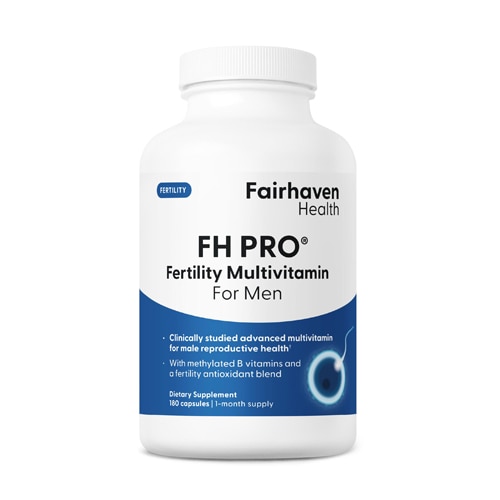
Fairhaven Health FH PRO Fertility Multivitamin for Men to Support Male Fertility & Sperm Health -- 180 Capsules


Fairhaven Health FH PRO Fertility Multivitamin for Men to Support Male Fertility & Sperm Health
  • Our price: $96.95

    $3.24 per serving

  • +

Added to My List as a guest.

Your guest list will be saved temporarily during your shopping session.

Sign in to add items to your saved list(s).

1 item added to your list

Fairhaven Health FH PRO Fertility Multivitamin for Men to Support Male Fertility & Sperm Health -- 180 Capsules

Oops! Something went wrong and we were unable to process your request. Please try again.

  • Guaranteed Authentic

    100% Authentic

    • ✓ Products sourced directly from brands or authorized distributors
    • ✓ No third-party resellers
    • ✓ Products stored and shipped in conditions that ensure quality
    • ✓ Vitacost is 100% committed to your well-being and safety

Fairhaven Health FH PRO Fertility Multivitamin for Men to Support Male Fertility & Sperm Health Description

  • FH PRO® Fertility Multivitamin For Men
  • Clinically Studied Advanced Multivitamin for Male Reproductive Health
  • With Methylated B Vitamins and a Fertility Antioxidant Blend
  • 1-Month Supply
  • Clean and Allergy-Friendly
  • Dairy, Soy & Egg Free
  • Gluten Free • Tree Nut, Peanut & Sesame Free
  • Fish & Shellfish Free
  • No Artificial Colors, Flavors & Sweeteners
  • No Unnecessary Binders, Fillers & Preservatives
  • Non-GMO

Premium male fertility dietary supplement to support sperm health


• Comprehensive formula, including key ingredients for male reproductive health such as L-carnitine tartrate, zinc, CoQ10, and lycopene
• Offers multivitamin support to fill in nutrient gaps in the diet
• Shown in a clinical study to help maintain normal sperm count, motility, and morphology
• Patented formula designed to support male reproductive health and fertility* (US Patent: #10,092,615 B2)


About FH PRO for Men


FH PRO for Men Offers Comprehensive Antioxidant, Vitamin and Mineral Support for Fertility and Sperm Health. FH PRO for Men is our patented, premium, antioxidant-based fertility supplement that was shown in a preliminary clinical study to support several aspects of sperm health compared to baseline including, count, motility, oxidative health, and DNA integrity. FH PRO for Men offers a 2-in-1 approach to reaching your health and fertility goals with a comprehensive multivitamin to address nutrients gaps in your daily diet, along with fertility targeted ingredients such as L-carnitine tartrate, L-arginine, CoQ10, zinc, and lycopene.


Clinically Studied to Support Many Aspects of Your Sperm Health. In a recent prospective clinical trial involving 148 men, study participants were given FH PRO for Men for a period of 3 months. Compared to pre-supplementation results, there were statistically significant improvements in sperm parameters including sperm count, progressive motility, and normal morphology after 3 months of taking FH PRO for Men. Also, significant results in DNA Fragmentation and Oxidation Reduction Potential were observed following supplementation. This study was performed at Hamad Medical Corporation in Doha, Qatar in consultation with the Cleveland Clinic in Ohio, and presented at the 2019 annual meeting of the American Society of Reproductive Medicine. (Arafa M, Agarwal A, Majzoub A, Khalafalla K, Alsaid S, and Elbardisi H. Efficacy of Antioxidant Supplementation on Conventional and Advanced Sperm Function Tests. Fertility and Sterility, Vol. 112, No. 3, Supplement, September 2019, e362).


Fortify Your Sperm with Key Fertility Ingredients In FH PRO for Men. Don’t make your partner do all of the work – be sure you are doing your part to reach your fertility goals. As part of a healthy diet and lifestyle, FH PRO for Men will fortify your sperm, with more than 25 key ingredients to support sperm health: L-Carnitine tartrate and L-Arginine; Zinc and Selenium; and Antioxidants, including Vitamins C and E, Beta Carotene, Lycopene and CoQ10.


Our Difference
Supporting women for life, from menstruation to menopause & beyond
Science-based hormone-free clean solutions
Practitioner-recommended, patient-loved
Straightforward practitioner and patient education
Quality assurance & safety protocols that go above and beyond


Directions

Suggested Use
As a dietary supplement, take 6 capsules daily or as recommended by your health care professional.
Free Of
Dairy, soy, egg, gluten, tree nut, peanut, sesame, fish, shellfish, artificial colors, flavors, sweeteners, binders, fillers, preservatives and GMOs.

*These statements have not been evaluated by the Food and Drug Administration. This product is not intended to diagnose, treat, cure, or prevent any disease.


Supplement Facts
Serving Size: 6 Capsules
Servings per Container: 30
Amount Per Serving% Daily Value
Vitamin A (as beta-carotene)1500 mcg RAE167%
Vitamin C (as ascorbic acid)120 mg133%
Vitamin D (as cholecalciferol) (Vitamin D3)30 mcg (1200 IU)150%
Vitamin E (as d-alpha tocopheryl succinate and d-alpha-tocopherol)134 mg893%
Thiamin (as thiamin HCl) (Vitamin B1)3 mg250%
Riboflavin (Vitamin B2) (as riboflavin 5-phosphate)3.4 mg262%
Niacin (as niacinamide)20 mg125%
Vitamin B6 (as pyridoxal-5-phosphate)25 mg1,471%
Folate (from L-5-methyltetrahydrofolate) (800 mcg folic acid)1360 mcg DFE340%
Vitamin B12 (as methylcobalamin)1000 mcg41,667%
Biotin (as d-biotin)600 mcg2,000%
Pantothenic Acid (as d-calcium pantothenate)20 mg400%
Iodine (as potassium iodide)150 mcg100%
Zinc (as zinc citrate)30 mg273%
Selenium (as L-selenomethionine)140255%
Copper (as copper glycinate)1 mg111%
Manganese (as manganese citrate)2 mg87%
Chromium (as chromium plynicotinate)120 mcg343%
Molybdenum (as molybdenum citrate)75 mcg167%
L-Carnitine L-Tartrate2000 mg*
L-Arginine350 mg*
Coenzyme Q10200 mg*
N-Acetyl L-Cysteine200 mg*
Vitamin K2 (as menaquinone-7)80 mcg*
Grape Extract (Vitis vinifera, seed, standardized to 85% polyphenols)20 mg*
Lycopene10 mg*
Benfotiamine1 mg*
*Daily value not established.
Other Ingredients: Cellulose, vegetarian capsule (cellulose), rice bran lipid, silica, mixed tocopherols (gamma, delta, beta).
The product you receive may contain additional details or differ from what is shown on this page, or the product may have additional information revealed by partially peeling back the label. We recommend you reference the complete information included with your product before consumption and do not rely solely on the details shown on this page. For more information, please see our full disclaimer.

View printable version Print Page

Eating for Fertility: A Dietitian's Guide Just for Men

[vc_row][vc_column][vc_column_text]When it comes to fertility, women tend to get all the attention. This is not too surprising, since women are the ones becoming pregnant and carrying the babies themselves. Yet let’s not forget that men are still responsible for half the equation when it comes to conception. The hard truth is that infertility has been on the rise in America for the past few decades. So, it’s time to take a closer look at male fertility, and specifically, how diet influences it.

A Man and Woman Share a Bowl of Cooked Vegetables, Representing a Diet to Improve Fertility in Males.

Is There a Diet to Improve Fertility in Males?

Research has shown that of all couples diagnosed with infertility, up to 50% of cases involve a male contributing factor. What’s more, sperm counts in men have been rapidly declining, falling 50% in the past 50 years, and continuing to drop about 1% per year. The causes behind this decline can include things like hormonal disorders, chronic illnesses, and testicular dysfunction. Yet more recently, unhealthy diet and lifestyle practices have been associated with male infertility and are thought to be a major contributor to declining sperm counts as well. Emerging evidence has linked a man’s diet with his semen quality — including sperm count, its motility, and its size and shape. Male diet has also been linked to a lesser extent with clinical outcomes such as how long it takes a couple to become pregnant, and how many go on to have a live birth. This declining semen quality, combined with the trend of couples having children later in life means it is becoming harder and harder to conceive naturally. But changing your diet may help.

How to Optimize Your Diet to Improve Male Fertility

The Western diet — which is typically high in sugar and fat, unbalanced and provides excessive calories — has been a significant contributor to the rapid increases in obesity over the past several decades. And studies show that obesity can have a significant effect on fertility by altering things like hormones and sperm function. But just because you may live in the West doesn’t mean you are subject to following the same dietary habits. Contrary to the Western diet, which is a risk factor for male infertility, the Mediterranean diet seems to protect against male infertility. If you’re wondering what this looks like in real life, here are some tips:

Pay attention to your fat sources.

Diets that are high in saturated fats negatively affect sperm quality, while unsaturated fats improve it. Foods high in saturated fats include many animal foods like red meat, full fat dairy products, and some oils like palm and coconut oil. Sources of unsaturated fat include foods like nuts, olive oil, and avocados. Studies report that omega-3 fats — a type of unsaturated fat — are particularly good for improving sperm quality by reducing oxidative damage, or damage to your body’s cells. Some food sources of omega-3’s include salmon, walnuts, and flaxseeds.

Load up on antioxidants.

Antioxidants are nutrients that help protect your body’s cells from damage by free radicals. More antioxidants are linked to higher sperm counts, and have been shown to be effective in the treatment and/or prevention of male infertility. Foods and beverages rich in antioxidants include colorful fruits and vegetables, cocoa beans and coffee.

Avoid highly processed meats.

Highly processed meats — like bacon, sausages and salami — have a harmful effect on fertility, not to mention other aspects of your health. The cause may come from factors such as its high content of saturated fat and the presence of preservatives. What’s more, processed red meat has been found to contain hormone residues that may negatively affect the body’s endocrine system, while unprocessed meat does not.

Cut back on added sugars.

High intakes of added sugar — especially from soft drinks — contribute to a decline in sperm concentration. Foods examples that are high in added sugar include many breakfast cereals, desserts and flavored yogurts or other snack foods. Note that natural sugars — such as those present in fruit and dairy — are not shown to be harmful to sperm.

Limit your alcohol intake.

Alcohol has been shown to negatively affect semen volume and reproductive hormones. What’s more, alcohol weakens the body’s antioxidant defenses, which can lead to oxidative stress — a condition that occurs when too many free radicals build up. Each of these factors, in turn, negatively impact male fertility. While the occasional drink in moderation likely isn’t going to cause much harm, excessive or frequent consumption can really take a toll. Note that in addition to diet, other factors such as excessive exercise, substance use and high blood pressure can also negatively impact fertility in both males and females. Non-modifiable factors like age and genetics can also play a role. All in all, studies show that a diet that is high in fish and healthy fats and low in sugary drinks and processed meats may improve male fertility. Gradually losing weight may also help improve many fertility issues in men, including reproductive hormone levels, better semen quality and sperm count.

In Summary

Male fertility is a big issue in America. Sperm counts have been steadily declining over many years, and men are responsible for up to half of the cases of infertility. While some of these contributing factors are non-modifiable, diet plays a large role, which can be changed. Consuming high amounts of antioxidants and healthy unsaturated fats, such as from fish, are shown to help improve male fertility. On the other hand, frequently eating highly processed red meats, sugary beverages, and alcohol can worsen fertility health. For men who are obese, gradually losing weight can also lead to improved fertility metrics. Couples who are dealing with fertility issues should have both partners evaluated by a doctor, and can work towards making small yet impactful changes to their diets where indicated.[/vc_column_text][/vc_column][/vc_row][vc_row][vc_column][vc_text_separator title="Featured Products" border_width="2"][vc_row_inner equal_height="yes" content_placement="middle" gap="35"][vc_column_inner width="1/3"][vc_single_image image="188141" img_size="full" alignment="center" onclick="custom_link" img_link_target="_blank" css=".vc_custom_1758476167142{padding-right: 7% !important;padding-left: 7% !important;}" link="https://www.vitacost.com/vitacost-certified-organic-walnuts-halves-pieces-non-gmo-kosher"][/vc_column_inner][vc_column_inner width="1/3"][vc_single_image image="188140" img_size="full" alignment="center" onclick="custom_link" img_link_target="_blank" css=".vc_custom_1758476178750{padding-right: 7% !important;padding-left: 7% !important;}" link="https://www.vitacost.com/taza-chocolate-organic-dark-chocolate-bar-stone-ground"][/vc_column_inner][vc_column_inner width="1/3"][vc_single_image image="188139" img_size="full" alignment="center" onclick="custom_link" img_link_target="_blank" css=".vc_custom_1758476189847{padding-right: 7% !important;padding-left: 7% !important;}" link="https://www.vitacost.com/antioxidant-solutions-non-gmo-juice-tart-cherry-with-splash-of-apple"][/vc_column_inner][/vc_row_inner][/vc_column][/vc_row]
Please enter a valid zip code
LVDC2