


skip to main content

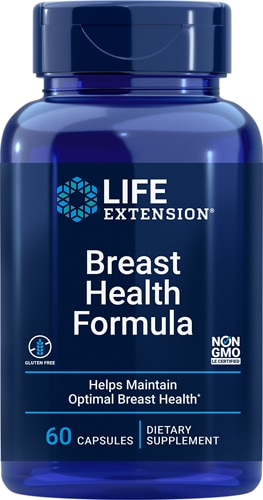
Life Extension Breast Health Formula -- 60 Capsules


Life Extension Breast Health Formula
  • Our price: $25.50

    $0.85 per serving

  • +

Added to My List as a guest.

Your guest list will be saved temporarily during your shopping session.

Sign in to add items to your saved list(s).

1 item added to your list

Life Extension Breast Health Formula -- 60 Capsules

Oops! Something went wrong and we were unable to process your request. Please try again.

  • Guaranteed Authentic

    100% Authentic

    • ✓ Products sourced directly from brands or authorized distributors
    • ✓ No third-party resellers
    • ✓ Products stored and shipped in conditions that ensure quality
    • ✓ Vitacost is 100% committed to your well-being and safety

Life Extension Breast Health Formula Description

  • Life Extension Breast Health Formula
  • Promotes Optimal Breast Health
  • Gluten-Free & Non-GMO

Now more than ever before, women are being proactive about supporting breast health. One important thing you can do is take action to maintain a healthy balance between “good” and “bad” estrogen. Breast Health Formula is a broad-spectrum formula that provides powerful nutrients to help support healthy estrogen balance and preserve optimal breast health.


Maintaining Optimal Breast Health
Estrogens are hormones produced primarily by the ovaries with important roles in woman’s breast health.But along with aging and oxidative stress, there are many estrogen-like compounds and other environmental factors that can influence the delicate estrogen balance and affect woman’s breast structure.


Research shows that specific botanical extracts can positively influence cellular health and remove some of the anxiety women face about maintaining a healthy balance of estrogens.


Promoting Healthy Estrogen Balance
Estrogen is broken down into several important metabolites in the body, including 2-hydroxyestrone, the one “good” for breast tissue, and 16 alpha-hydroxyestrone, the one undesirable for breast tissue.Evidence shows that increased 2-hydroxyestrone and ratio between 2-hydroxyestrone and 16 alpha-hydroxyestrone is important for optimal breast health.


Scientists have identified nutrients such as indole-3-carbinol (I3C), present in cruciferous vegetables, that can promote cellular health and tip the delicate balance of estrogens in favor of the good form.


Women seeking proactively to promote youthful hormonal balance can take this phytonutrient-based formula to help support healthy estrogen balance.


Powerful Botanical Formula
Some of the active ingredients in the Breast Health Formula are:


Phytoestrogens that are plant-derived compounds abundant in soy. Soy isoflavones can bind to estrogen receptors in the body and either have weak estrogen effects or block estrogen effects.They can also favorably alter the ratio between 2-hydroxyestrone and 16-hydroxyestrone.

Flaxseed lignans that boost levels of beneficial enterolactone, which looks like estrogen and favorably maintains estrogen metabolism.

Cruciferous Vegetable Extracts (such as I3C) that effectively increase 2-hydroxyestrone while reducing undesirable 16 alpha-hydroxyestrone.

Calcium d-Glucarate to help support liver health, which helps remove estrogen from the body.

Vitamin D to support healthy DNA and protect cells from free radical damage.


• Breast health supplement – Go beyond a mammogram and be proactive with this phytonutrient-based botanical formula designed from the ground up to support breast health as you age.


• Hormone balance support – Healthy hormones are vital to lasting breast health. This formula encourages hormone health with broccoli extract, soy isoflavones and other phytoestrogens.


• Promotes DNA health – Oxidative stress can impact breast health. This formula contains vitamin D3, broccoli extract, indole-3-carbinol, soy isoflavones and other breast-friendly nutrients to support healthy DNA and protect healthy breast tissue.


• Ingredients matter - Sourced using only the finest raw ingredients with the quality and purity your body deserves. The majority of our products are non-GMO, gluten-free and manufactured in the USA—and a Certificate of Analysis is available for every product we produce.


• Live your healthiest life – We believe the answers to a healthier life are in reach, and that scientific research is the key to getting there. That’s why so many of our formulas feature specific ingredients and amounts based on scientific studies.


Directions

Take two (2) capsules daily for individuals weighing up to 160 lbs., and for those weighing over 160 lbs., take three (3) to four (4) capsules daily, or as recommended by a healthcare practitioner. This product can be taken, or as recommended by a healthcare practitioner.
Free Of
GMOs, gluten.

*These statements have not been evaluated by the Food and Drug Administration. This product is not intended to diagnose, treat, cure, or prevent any disease.


Supplement Facts
Serving Size: 2 Capsules
Servings per Container: 30
Amount Per Serving% Daily Value
Vitamin D3 (as cholecalciferol)25 mcg125%
Calcium (as calcium D-glucarate)16.5 mg1%
Iodine (as potassium iodide)2 mg1,333%
Proprietary Cruciferous Vegetable Blend
Broccoli super concentrate extract (seed and plant) [providing glucosinolates]; wasabi powder (rhizome)
450 mg*
I3C (Indole-3-carbinol)100 mg*
Proprietary Enterolactone Precursors Blend
Flax lignan extract (seed) [providing secoisolariciresinol diglucoside (SDG)]; HMRlignan™ Norway spruce (Picea abies) lignan extract (knot wood) [std. to 90% hydroxymatairesinol potassium acetate]
65 mg*
Soybean extract (seed) [std. to 40% total Isoflavones], providing 15% genistein, 14% daidzein].35 mg*
DIM (3,3'-diindolylmethane)14 mg*
*Daily value not established.
Other Ingredients: Vegetable cellulose (capsule), microcrystalline cellulose, maltodextrin, stearic acid, silica, food starch-modified.

Contains soybeans.

Warnings

Keep Out of Reach of Children
Do Not Exceed Recommended Dose
Do not purchase if outer seal is broken or damaged.
When using nutritional supplements, please consult with your physician if you are undergoing treatment for a medical condition or if you are pregnant or lactating.

The product you receive may contain additional details or differ from what is shown on this page, or the product may have additional information revealed by partially peeling back the label. We recommend you reference the complete information included with your product before consumption and do not rely solely on the details shown on this page. For more information, please see our full disclaimer.
View printable version Print Page

What Can DNA Test Kits Tell You About Your Health?

For years, thanks to heavily marketed genetic tests from companies like AncestryDNA and 23andMe, we’ve been able to find out whether our ancestors were primarily from England or Egypt, or they were mostly from Spain or South Africa. Now, more and more of us are going beyond our heritage and taking genetic tests to learn about our health — whether we’re at greater risk for conditions like breast cancer and Alzheimer’s disease, for instance.

Woman Standing in Kitchen Browsing Letter Explaining Different Types of Genetic Testing | Vitacost.com/blog

Experts caution, though, that one batch of genetic test results shouldn’t be your sole guide for figuring out how to prepare for a future that might include a potentially debilitating or deadly disorder. As with most healthcare matters, it’s just not that simple.

Certified genetic counselor Scott Weissman, founder of Chicago Genetic Consultants in Northbrook, Illinois, explains that genetic testing to gain insights into your health comes in three forms.

1. Direct-to-consumer tests

The chief example of direct-to-consumer tests is 23andMe, which sells both ancestry-only tests ($99 each) and ancestry-plus-health tests ($199). AncestryDNA, the main rival of 23andMe, doesn’t offer health-related tests.

The direct-to-consumer test from 23andMe can indicate genetic risks for conditions such as certain types of cancer, such as variations of breast and ovarian cancer; lung and liver disease; late-onset Alzheimer’s disease; Parkinson’s disease; and celiac disease. Additionally, it can zero in on whether someone is a carrier of genetic disorder like cystic fibrosis and sickle cell anemia but doesn’t show symptoms of it.

Unfortunately, direct-to-consumer tests do have shortcomings, according to Weissman. For instance, anyone can order a direct-to-consumer test; permission from a healthcare provider isn’t required.

Nonetheless, Weissman says the health-oriented information supplied by 23andMe is “pretty accurate.” However, while the 23andMe health test can signal a greater risk for breast, ovarian or prostate cancer in people of Ashkenazi Jewish descent, the U.S. Food and Drug Administration (FDA) instructs consumers and healthcare professionals not to use these test results to determine cancer treatments. Such decisions should be made after follow-up testing and genetic counseling, the FDA says.

Weissman advises consumers to “really take the time to read the fine print about what is in these tests before clicking ‘yes’ and buying a test.”

Weissman also urges caution in handling raw data that ancestry-test providers like AncestryDNA and 23andMe enable customers to download. This data can be uploaded to a third-party website and then interpreted through a healthcare lens, he says, but the results are “potentially unreliable” and could be filled with errors.

Before entrusting raw genetic data to a third-party site for healthcare purposes, Weissman recommends consulting with a genetics professional like a certified genetic counselor. That professional can address questions and concerns that a typical consumer — someone lacking expertise about genetics — might have before and after a third-party review, he says.

To find a certified genetic counselor in your area, visit aboutgeneticcounselors.com, a website operated by the National Society of Genetic Counselors.

2. Consumer-initiated tests

Unlike a direct-to-consumer test, a healthcare provider must sign off on a consumer-initiated (or consumer-directed) test, which supplies information about genetic risks associated with an array of disorders. Typically, a provider of a consumer-initiated test employs genetic counselors who can answer a consumer’s questions and help decipher test results.

These tests involve a general look at your genetic makeup known as genotyping. As explained by Helix, a provider of these tests, genotyping “is like reading a few scattered words on a page.” By contrast, the narrower type of tests — called gene sequencing — “reads whole sentences, paragraphs and chapters.”

Weissman suggests meeting with a genetic counselor before proceeding with a consumer-initiated test so that he or she can answer questions or allay concerns.

Helix and Color are among the major providers of these tests. As of October 2018, Helix’s healthcare tests were priced from $164.99 to $239.99, while Color’s tests normally sell for $249.

3. Gene-sequencing tests

Gene-sequencing tests are the Cadillac of genetic tests.

As opposed to direct-to-consumer and consumer-initiated tests, “highly accurate” gene-sequencing tests are ordered by a healthcare professional, according to Weissman. Through a thorough lab analysis of the gene-sequencing results, heightened risks of genetic disorders can be identified with “very high” certainty, he says.

One word of warning: These tests can cost $1,500 to $2,000 apiece, but they’re often covered by insurance, according to Weissman.

What’s the bottom line?

The American Medical Association (AMA), the largest U.S. organization for physicians, stresses that the results of genetic tests — no matter what kind they are — can be difficult to interpret and should be taken into context (such as family history and other health conditions).

“A positive result does not always indicate a clinical diagnosis. Instead, it may indicate an increased risk for developing a disease or condition,” the AMA says. “Similarly, a negative result is not indicative of the absence of disease risk.”

Women’s advocate Kaitlin Nordby, a hereditary cancer educator who is founder and CEO of Well Woman, believes genetic tests can be “incredibly helpful” when something can be done to either prevent a condition from occurring or reduce the risk. But in the case of a disease like Alzheimer’s, a test might detect a greater risk for it, yet there’s no known way to prevent or cure it, she cautions.

“If there is nothing you can do to prevent that outcome, it’s like finding out the date and time you are going to die. Is that useful?” Nordby says.

Saad Alam says he’s found genetic testing useful.

Alam, the 36-year-old founder and CEO of Prime, a healthcare brand that empowers men in their 30s and upward to combat the mental and physical challenges of aging, says he performed five at-home genetic tests to help him get a leg up on the aging process. He says the tests indicated, for instance, a vitamin D deficiency and an increased risk for osteoarthritis, and led to a plan to counteract them.

Such tests, however, are not the end-all and be-all regarding your health, Alam advises. The tests gave him “information that most physicians may not look into,” he says. “But I have to work with my physician to make good, sound decisions.”

Please enter a valid zip code
LVDC2