


skip to main content

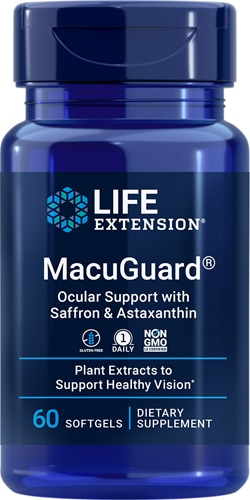
Life Extension MacuGuard Ocular Support with Saffron & Astaxanthin -- 60 Softgels


Life Extension MacuGuard Ocular Support with Saffron & Astaxanthin
  • Our price: $32.25

    $0.54 per serving

  • +

Added to My List as a guest.

Your guest list will be saved temporarily during your shopping session.

Sign in to add items to your saved list(s).

1 item added to your list

Life Extension MacuGuard Ocular Support with Saffron & Astaxanthin -- 60 Softgels

Oops! Something went wrong and we were unable to process your request. Please try again.

  • Guaranteed Authentic

    100% Authentic

    • ✓ Products sourced directly from brands or authorized distributors
    • ✓ No third-party resellers
    • ✓ Products stored and shipped in conditions that ensure quality
    • ✓ Vitacost is 100% committed to your well-being and safety

Life Extension MacuGuard Ocular Support with Saffron & Astaxanthin Description

  • When it Comes to the Future, You Want To See Far
  • Protect the Eye’s Delicate Photoreceptor Cells, Promote Retinal Health, Fight Eye Fatigue and Support Healthy Vision with this Macuguard Formula
  • It has Vitamins and Nutrients like Lutein, Zeaxanthin, Saffron and Astaxanthin, Which Have Been Shown to Benefit Eye Health
  • Lutein, Zeaxanthin And Meso-Zeaxanthin Protect the Eyes from Both Digital Device Blue Light and Ultraviolet Light, and They Help Defend the Eyes Against Excessive Oxidative Stress
  • To Help Get These Nutrients Where You Need Them Most—the Retina of the Eye—This Formula uses Phospholipids to Promote Absorption
  • And Did Your Eyes Spy the Saffron Extract in This Formula?
  • It Has Been Added to Help Promote Sharp Vision and Ocular Health
  • The Astaxanthin in this Formula Adds to Your Ocular Arsenal, Helping to Fight Eye Fatigue and Supporting Healthy Vision and Overall Eye Health

The nutrients our eyes need are often hard to come by, but it’s worth making sure we get enough of them to keep our eyes healthy over time. For instance: the carotenoids lutein and zeaxanthin are the main components of your macular pigment and help protect the eyes from the effects of excess blue and ultraviolet light.


Lutein & Zeaxanthin: vital for healthy vision
That's why this formula contains lutein, zeaxanthin and meso-zeaxanthin, as well as alpha-carotene, another eye health carotenoid that has been associated with protection of the macula and retina.Lutein and the two types of zeaxanthin are very well-known to help preserve the health of the macula and act as defenders against excessive oxidative stress. They help keep eyes functioning well, even over time.


Astaxanthin: fight eye fatigue
Japanese scientists have clinically studied astaxanthin. They’ve demonstrated that 6 mg of astaxanthin supplementation daily helped promote visual sharpness and eye health.


Phospholipids for carotenoids: optimal absorption
Getting these eye-healthy nutrients where you need them most is a huge part of supporting your vision health. This formula contains phospholipids, which are an integral part of every cell membrane in the body. This helps promote absorption of lutein and zeaxanthin. Good absorption is crucial for these nutrients to make it into the retina of the eye.


Vision-enhancing benefits of saffron
This formula also includes saffron extract. Multiple clinical studies have shown that those with age-related vision concerns, supplementing with saffron helped support visual acuity, as measured both by advanced technical testing and on the Snellen eye chart that is commonly used by doctors to test vision.


• Lutein and zeaxanthin for macular support – Step up your eye care and protect the eye’s delicate photoreceptor cells with lutein, zeaxanthin and meso-zeaxanthin, which promote the eye’s macular and retinal health. Protect your eyes from ultraviolet light, oxidative stress, and the effects of the blue light emitted by digital devices with lutein and zeaxanthin.


• Supports visual acuity – Keep your vision sharp with saffron extract. The saffron in this formula supports optimal eye health and helps promote sharp, healthy vision.


• Fight back against eye fatigue – The astaxanthin (a compound derived from sea algae) in this MacuGuard formula helps fight eye fatigue and promotes sharp, healthy vision.


• Ingredients matter – We use only the finest raw ingredients with the purity and potency you deserve. The majority of our products are non-GMO, gluten-free and manufactured in the USA—and a Certificate of Analysis is available for every one.


• Live your healthiest life - For over 40 years, we’ve been developing advanced, effective formulas made with the highest standards and based on the latest scientific findings. We believe the answers to a healthier, richer life are within reach, and that rigorous scientific research is the path to get us there. That’s why so many of our nutritional formulas are designed using specific ingredients and amounts based on scientific studies.


Directions

Take one (1) softgel daily, with food, or as recommended by a healthcare practitioner. Based on scientific studies, this formula is enhanced with phospholipids to increase lutein absorption.

Free Of
GMOs, gluten.

*These statements have not been evaluated by the Food and Drug Administration. This product is not intended to diagnose, treat, cure, or prevent any disease.


Supplement Facts
Serving Size: 1 Softgel
Servings per Container: 60
Amount Per Serving% Daily Value
MacuGuard® Proprietary Blend
Marigold extract (Tagetes erecta ) (flower) [providing 10 mg lutein, 4 mg meso -zeaxanthin & zeaxanthin], phospholipids, mixed carotenoids [providing 1.24 mg a-carotene]
208 mg*
Saffron extract (stigma)20 mg*
Natural astaxanthin [from Haematococcus pluvialis algae]6 mg*
*Daily value not established.
Other Ingredients: Extra virgin olive oil, gelatin, glycerin, sunflower oil, purified water, palm oil, beeswax, acacia gum, maltodextrin, annatto color.
Warnings

Keep Out of Reach of Children. Do Not Exceed Recommended Dose. Do not purchase if outer seal is broken or damaged. When using nutritional supplements, please consult with your physician if you are undergoing treatment for a medical condition or if you are pregnant or lactating. To report a serious adverse event or obtain product information, contact 1-866-280-2852.

The product you receive may contain additional details or differ from what is shown on this page, or the product may have additional information revealed by partially peeling back the label. We recommend you reference the complete information included with your product before consumption and do not rely solely on the details shown on this page. For more information, please see our full disclaimer.
View printable version Print Page

Why Are Some Vitamins and Supplements More Expensive Than Others?

Taking vitamins and supplements on a regular basis is hardly the anomaly it once was: The national vitamin and supplement market topped off at $33 billion in 2019, rendering it one of the largest industries in the U.S. People are becoming increasingly health-conscious, and with it has arrived a growing interest in supplementing with everything from vitamin D to turmeric.

Torso View of Woman Shopping for Supplements Holding Two Bottles and Wondering if Expensive Vitamins are Better Than Cheap Ones | Vitacost.com/blog

Whether you’ve been supplementing for years or are just now hopping on the bandwagon, one question perplexes many: Why are some vitamins and supplements more expensive than others?

Here’s why—and how you can ensure you’re buying the right type for you and your family:

Ingredients

Some argue that inexpensive vitamins are just as effective as pricey choices, and while this may be true—read on—the type of ingredients in the supplement you’re buying is of utmost importance (and can mean the difference between paying $18 for iron rather than $3.99). Several vitamin and supplement manufacturers use fillers and “shelf-extenders” than can range from talc to  hydrogenated oils, which may sound harmless but can have detrimental effects on your health. Vitamins and supplements are exempt from FDA regulation, meaning that “manufacturers are legally allowed to go to market with their product without proving their purity levels to anyone,” Today reports.

The onus, then, is on you. Conduct research, see if the product has been tested (see below), and know the percentage of the key ingredients to look for. Additionally, you can check the National Institutes of Health’s free fact sheet to get the info you need.

Marketing

Vitamins that cost three times more than their counterparts? Consider the marketing campaigns behind them. As the Globe & Mail puts it, “Most of us buy from names we know,” and those are names we see everywhere from our latest issue of Prevention to Facebook. As the Globe & Mail also reports, “After years of exposure to advertising, we instinctively trust the brands we recognize.” Advertising requires dollars, so, naturally, the prices will be higher.

Medical-Grade Supplements vs. Over-the-Counter Supplements

“Many people ask me about medical-grade supplements vs. other-the-counter (OTC) supplements that can be purchased at outside stores or online,” says Dr. Lynne Mielke. “Is your OTC multivitamin the same thing that you can get at a medical office? In a word: No.” Some OTC supplements, for example, use inexpensive, synthetic forms, while those prescribed in an office “usually contain the best forms of these vitamins, to ensure that your body is getting the most natural and effective form of the vitamin—even if it costs a little more,” Mielke adds. Additionally, OTC products generally contain a lower dosage than a medically-prescribed supplement. Take niacin, for example. Praised for its ability to support a number of benefits—including digestive health and your skin—experts say that a prescription-strength is needed for it to be effective.

Is this to say that all of your vitamins and supplements need to be prescribed by a health professional? While you definitely need to consult with your doctor first (better yet, ask for a blood test to see what you may be lacking), quality brands that refrain from using inexpensive ingredients can be just as valuable.

“Personalized” Vitamins and Supplements

One of the freshest trends in the vitamin and supplement industry is personalized vitamins (indeed, advertisements for them may be cramming your IG feed as you read this). Often accompanied by a quiz, which tracks everything from whether or not you eat red meat to your workout schedule, these companies provide specially-tailored recommendations based on lifestyle, age, gender, and nutritional needs. While the verdict is still out on whether this is simply a clever marketing strategy, what holds true is this: These vitamins and supplements run on the higher end.

Quality

Above all, the price of vitamins and supplements often comes down to quality. As former investigator for the FDA Gary Collins, MS, says, “The fact is, it costs money to make quality dietary supplements such as vitamins, proteins, fish oil capsules, energy bars, herbal blends, and/or sports nutrition products.” Counterfeit products run rampant, particularly on the internet.

Fake supplements can contain everything from dangerous amounts of the active ingredient, to none of the “active” ingredient at all, to sawdust (yes, sawdust)—and because the vitamin and supplement industry isn’t tightly regulated (and the fact that counterfeit companies can get the necessary paperwork to peddle their products), the consumer is left unawares. And even if the company isn’t completely fraudulent, their product might not be as fabulous as their label makes them out to be: ConsumerLab, for example, found that roughly 30 percent of multivitamins do not absorb properly, or have more or less of the stated item.

Does that mean you should go with the most expensive brand on the shelf? Absolutely not. As The New York Times points out, “Vitamins and minerals are commodity items, and every manufacturer has access to the same ingredients. For that reason, researchers and scientists say paying more for a name brand won’t necessarily buy you better vitamins.” Eric Rimm, associate professor of epidemiology and nutrition at the Harvard School of Public Health, adds to this by saying, “When we measure levels of vitamins in the blood, we find the levels are the same whether the person was taking a generic brand or a name brand.”

That said, it’s also advised that you don’t go too cheap. Rather, choose a brand with a solid reputation—and who restocks often. “Vitamins lose their potency over time and must be stored at, or below, room temperature,” The New York Times reports. “If bottles are sitting on a shelf in a warm room or in direct sunlight, they may degrade even before their expiration date.”

Testing

That bottle of vitamin E you’re eyeing may cost less than the name brand displayed a shelf above, but have you checked to see if the product has been adequately tested? Good manufacturers get a stamp of approval from NSF International, ConsumerLab, and/or the United States Pharmacopeia, who assess for safety, efficacy, and quality. Those that haven’t received a seal approval aren’t necessarily of poor quality, but you will know what you’re paying for. Which, given that it’s about your health, is priceless

Please enter a valid zip code
FLDC19