


 Before our nom-noms reveal, a brief primer on your fatty blood draw: Broadly speaking, a cholesterol reading under 200 is good. But that number alone doesn't damn or free you. What matters more are the components that create your overall cholesterol: high-density lipoprotein (HDL) and low-density lipoprotein (LDL), along with triglycerides, which are mainly in very low density lipoprotein (VLDL).
“An easy rule of thumb is that HDL are the good guys, designed to bind to excess cholesterol and remove it from your body,” says Dr. Vikki Petersen, a chiropractor certified in clinical nutrition and functional medicine, who co-founded Root Cause Medical Clinic, located in California and Florida. “LDLs and VLDLs are the bad guys, as they are more involved in depositing cholesterol in such places as your arteries.” As cholesterol builds up, it's harder for blood to flow, which can lead to a heart attack or stroke.
“Generally, it is felt that as long as your HDLs are on the higher end of the range and your LDLs are on the lower end, you are fairly safe from heart disease,” Petersen says. You can learn about the range thresholds via reputable sources such as Cleveland Clinic and Harvard Health Publishing.
A more detailed test analyzes the particle size of cholesterol molecules, which is helpful if someone is at risk for heart disease based on their history and genetics, for example. “This test will tell you if your bad cholesterol is particularly dangerous due to its small size,” Petersen says. “Larger sized particles are more innocuous because they cannot lodge between the cells lining your arteries, which initiates dangerous plaque and leads to hardening of the arteries.”
Keep in mind that cholesterol, which your body produces on its own, can be your ally. “When balanced and healthy, it is needed to survive,” Petersen notes. It helps cells function properly, absorbs fat from food (via bile, which cholesterol helps your liver produce) and makes cortisol, vitamin D and sex hormones.
Now for the yummy part, aka lowering your cholesterol with food.
Before our nom-noms reveal, a brief primer on your fatty blood draw: Broadly speaking, a cholesterol reading under 200 is good. But that number alone doesn't damn or free you. What matters more are the components that create your overall cholesterol: high-density lipoprotein (HDL) and low-density lipoprotein (LDL), along with triglycerides, which are mainly in very low density lipoprotein (VLDL).
“An easy rule of thumb is that HDL are the good guys, designed to bind to excess cholesterol and remove it from your body,” says Dr. Vikki Petersen, a chiropractor certified in clinical nutrition and functional medicine, who co-founded Root Cause Medical Clinic, located in California and Florida. “LDLs and VLDLs are the bad guys, as they are more involved in depositing cholesterol in such places as your arteries.” As cholesterol builds up, it's harder for blood to flow, which can lead to a heart attack or stroke.
“Generally, it is felt that as long as your HDLs are on the higher end of the range and your LDLs are on the lower end, you are fairly safe from heart disease,” Petersen says. You can learn about the range thresholds via reputable sources such as Cleveland Clinic and Harvard Health Publishing.
A more detailed test analyzes the particle size of cholesterol molecules, which is helpful if someone is at risk for heart disease based on their history and genetics, for example. “This test will tell you if your bad cholesterol is particularly dangerous due to its small size,” Petersen says. “Larger sized particles are more innocuous because they cannot lodge between the cells lining your arteries, which initiates dangerous plaque and leads to hardening of the arteries.”
Keep in mind that cholesterol, which your body produces on its own, can be your ally. “When balanced and healthy, it is needed to survive,” Petersen notes. It helps cells function properly, absorbs fat from food (via bile, which cholesterol helps your liver produce) and makes cortisol, vitamin D and sex hormones.
Now for the yummy part, aka lowering your cholesterol with food.
NOW Supplements Available at Vitacost
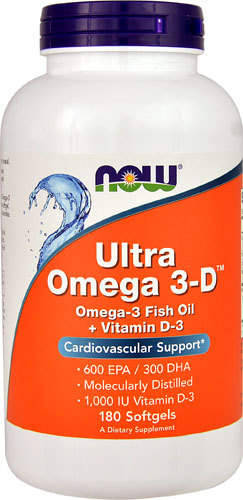
NOW Ultra Omega 3-D Description
-
Omega-3 Fish Oil + Vitamin D-3
-
Cardiovascular Support
-
600 EPA / 300 DHA
-
Molecularly Distilled
-
1,000 IU Vitamin D-3
-
In Fish Gelatin Softgel
-
Non-GMO
Now® Ultra Omega 3-D™ is our most potent Omega-3 formula, with 600 mg EPA and 300 mg DHA per softgel. This product is flavored with lemon oil and also provides 1,000 Vitamin D-3.
This fish Concentrate is manufactured under strict quality control standards. It is tested to be free of potentially harmful levels of contaminants such as PCBs, dioxins, mercury and other heavy metals. This product utilizes a fish gelatin softgel providing an alternative to bovine and porcine gelatin softgels.
Supportive but not conclusive research shows that consumption of EPA and DHA omega-3 fatty acids may reduce the risk of coronary heart disease.
Directions
Suggested Usage: Take 1 softgel daily with a meal.
Free Of
GMOs.
*These statements have not been evaluated by the Food and Drug Administration. This product is not intended to diagnose, treat, cure, or prevent any disease.
Supplement Facts
Serving Size: 1 Softgel
Servings per Container: 180
| Amount Per Serving | % Daily Value | |
| Calories | 15 | |
| Total Fat | 1.5 g | 2% |
| Cholesterol Less than | 5 mg | 1% |
| Vitamin D3 (as Cholecalciferol) (from Lanolin) | 25 mcg (1000 IU) | 125% |
| Fish Oil Concentrate | 1.2 g (1200 mg) | * |
| Omega-3 Fatty Acids | ||
| Eicosapentaenoic Acid (EPA) | 600 mg | * |
| Docosahexaenoic Acid (DHA) | 300 mg | * |
*Daily value not established.
Other Ingredients: Softgel capsule (fish gelatin, glycerin, water), lemon oil and d-alpha tocopherol.
Contains fish (anchovies, sardines) and fish gelatin (tilapia, bass). d-alpha Tocopherol from non-GMO soy.
Not manufactured with wheat, gluten, corn, milk, egg or shellfish ingredients. Produced in a GMP facility that processes other ingredients containing these allergens.
Warnings
For adults only. Consult physician if pregnant/nursing, taking medication, or have a medical condition.
Natural color variation may occur in this product.
The product you receive may contain additional details or differ from what is shown on this page, or the product may have additional information revealed by partially peeling back the label. We recommend you reference the complete information included with your product before consumption and do not rely solely on the details shown on this page. For more information, please see our full disclaimer.
