

skip to main content

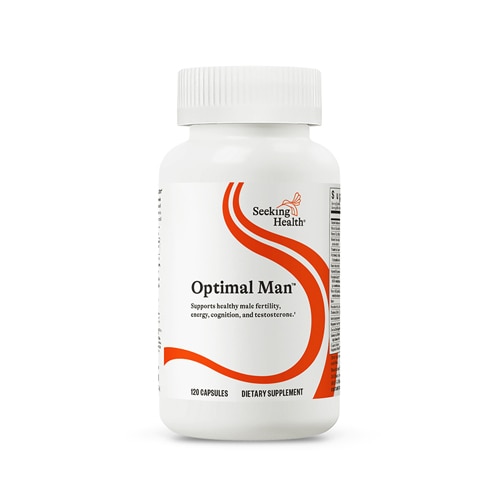
Seeking Health Optimal Man -- 120 Capsules


Seeking Health Optimal Man
  • Our price: $65.00

    $2.17 per serving

  • +
+ Add to My List

Add to a list


or

Create a List

1 item added to your list

Seeking Health Optimal Man -- 120 Capsules

Oops! Something went wrong and we were unable to process your request. Please try again.

  • Guaranteed Authentic

    100% Authentic

    • ✓ Products sourced directly from brands or authorized distributors
    • ✓ No third-party resellers
    • ✓ Products stored and shipped in conditions that ensure quality
    • ✓ Vitacost is 100% committed to your well-being and safety

Seeking Health Optimal Man Description

  • Supports Healthy Male Fertility, Energy, Cognition, and Testosterone
  • Supports Healthy Cognition, Energy and Aging Processes
  • Supports Men's Health

Seeking Health® Believe in Better®


Optimal Man™ provides numerous trademarked ingredients in potent amounts.


Who Needs Optimal Man™?
Are your customers/patients looking to support their health and the health of their unborn children? Do they know that male prenatal health is just as important as female prenatal health?


Are your customers/patients looking for a men’s multivitamin? They are in the prime of life, and their health should be a priority.


At the point of conception, genetics are passed along to the future child. Did you know that your genes can change expression based on nutrition and environment? This means a child can inherit those epigenetic markers. Supporting your customers’/patients’ genes prior to conception can help pass along their “best” genes to their
child.


Optimal Man™ is a one-of-a-kind men’s health supplement. It is made up of essential nutrients, vitamins, minerals, unique herbs, and antioxidants.


Directions

Suggested Use: As needed, take 4 capsules in divided doses. 2 capsules after a protein based breakfast and, if needed, 2 capsules after lunch. Use as directed by your healthcare professional.
Free Of
Dairy, eggs, fish, shellfish, tree nuts, peanuts, wheat, soy, sesame, gluten, GMOs, artificial colors, and artificial flavors.

*These statements have not been evaluated by the Food and Drug Administration. This product is not intended to diagnose, treat, cure, or prevent any disease.


Supplement Facts
Serving Size: 4 Capsules
Servings per Container: 30
Amount Per Serving% Daily Value
Vitamin A (as beta-carotene and retinyl palmitate)1500 mcg RAE167%
Vitamin C (as ascorbic acid)100 mg111%
Vitamin D (as cholecalciferol)100 mcg (4000 IU)500%
Vitamin E (as d-alpha tocopheryl acid succinate)45 mg300%
Thiamin (as thiamine hydrochloride)50 mg4,167%
Riboflavin (as riboflavin 5'-phosphate sodium)5 mg385%
Niacin (nicotinic acid)25 mg NE156%
Vitamin B6 (as pyridoxal 5'-phosphate)15 mg882%
Folate [as Quatrefolic® (6S)-5-methyltetrahydrofolate, glucosamine salt and calcium folinate]680 mcg DFE (400 mcg)170%
Vitamin B12 (as MecobalActive® methylcobalamin and adenosylcobalamin)100 mcg4,167%
Biotin250 mcg833%
Pantothenic Acid (as D-Calcium Pantothenate)25 mg500%
Choline (as Choline L-(+)-bitartrate) (VitaCholine®)150 mg27%
Iodine (as potassium iodide)200 mcg133%
Magnesium (as Di-Magnesium Malate) (Albion®)100 mg24%
Zinc (as Zinc Bisglycinate Chelate) (Albion®)25 mg227%
Selenium (as SelenoExcell® High Selenium Yeast)100 mcg182%
Copper (as Copper Bisglycinate Chelate) (Albion®)1.5 mg167%
Manganese (as Manganese Bisglycinate Chelate) (Albion®)2 mg87%
Chromium (as chromium picolinate)150 mcg429%
L-Carnitine (as L-Carnitine Tartrate)250 mg*
Eurycoma Longifolia Extract (Eurycoma longifoliajack) (root) (LJ100®)200 mg*
Maca Powder (Lepidium meyenii) (root)200 mg*
Betaine Anhydrous (trimethylglycine)150 mg*
Ashwagandha Extract (KSM-66®) (Withania somnifera)150 mg*
DIM (Diindolymethane) (CetiVI™)100 mg*
Ginseng Extract (Panax ginseng) (root)100 mg*
Alpha-Lipoic Acid50 mg*
Coenzyme Q10 (MicroActive® CoQ10)25 mg*
Ginger (Zingiber officinale) (rhizome) (Ginfort®)25 mg*
S-Acetyl-L-Glutathione (Emothion®)25 mg*
SOD (Superoxide Dismutase) [from Melon Extract (Cucumis melo)] (Extramel®)10 mg*
Boron (as Bororganic Glycine) (Albion®)5 mg*
Mixed Tocopherols5 mg*
Lutein5 mg*
Zeaxanthin4 mg*
Vitamin K2 (as menaquinone-7) (vitaMK7®)100 mcg*
*Daily value not established.
Other Ingredients: Vegetarian capsule (hypromellose and water), ascorbyl palmitate, l-leucine, and silica.
The product you receive may contain additional details or differ from what is shown on this page, or the product may have additional information revealed by partially peeling back the label. We recommend you reference the complete information included with your product before consumption and do not rely solely on the details shown on this page. For more information, please see our full disclaimer.

View printable version Print Page

Eating for Fertility: A Dietitian's Guide Just for Men

[vc_row][vc_column][vc_column_text]When it comes to fertility, women tend to get all the attention. This is not too surprising, since women are the ones becoming pregnant and carrying the babies themselves. Yet let’s not forget that men are still responsible for half the equation when it comes to conception. The hard truth is that infertility has been on the rise in America for the past few decades. So, it’s time to take a closer look at male fertility, and specifically, how diet influences it.

A Man and Woman Share a Bowl of Cooked Vegetables, Representing a Diet to Improve Fertility in Males.

Is There a Diet to Improve Fertility in Males?

Research has shown that of all couples diagnosed with infertility, up to 50% of cases involve a male contributing factor. What’s more, sperm counts in men have been rapidly declining, falling 50% in the past 50 years, and continuing to drop about 1% per year. The causes behind this decline can include things like hormonal disorders, chronic illnesses, and testicular dysfunction. Yet more recently, unhealthy diet and lifestyle practices have been associated with male infertility and are thought to be a major contributor to declining sperm counts as well. Emerging evidence has linked a man’s diet with his semen quality — including sperm count, its motility, and its size and shape. Male diet has also been linked to a lesser extent with clinical outcomes such as how long it takes a couple to become pregnant, and how many go on to have a live birth. This declining semen quality, combined with the trend of couples having children later in life means it is becoming harder and harder to conceive naturally. But changing your diet may help.

How to Optimize Your Diet to Improve Male Fertility

The Western diet — which is typically high in sugar and fat, unbalanced and provides excessive calories — has been a significant contributor to the rapid increases in obesity over the past several decades. And studies show that obesity can have a significant effect on fertility by altering things like hormones and sperm function. But just because you may live in the West doesn’t mean you are subject to following the same dietary habits. Contrary to the Western diet, which is a risk factor for male infertility, the Mediterranean diet seems to protect against male infertility. If you’re wondering what this looks like in real life, here are some tips:

Pay attention to your fat sources.

Diets that are high in saturated fats negatively affect sperm quality, while unsaturated fats improve it. Foods high in saturated fats include many animal foods like red meat, full fat dairy products, and some oils like palm and coconut oil. Sources of unsaturated fat include foods like nuts, olive oil, and avocados. Studies report that omega-3 fats — a type of unsaturated fat — are particularly good for improving sperm quality by reducing oxidative damage, or damage to your body’s cells. Some food sources of omega-3’s include salmon, walnuts, and flaxseeds.

Load up on antioxidants.

Antioxidants are nutrients that help protect your body’s cells from damage by free radicals. More antioxidants are linked to higher sperm counts, and have been shown to be effective in the treatment and/or prevention of male infertility. Foods and beverages rich in antioxidants include colorful fruits and vegetables, cocoa beans and coffee.

Avoid highly processed meats.

Highly processed meats — like bacon, sausages and salami — have a harmful effect on fertility, not to mention other aspects of your health. The cause may come from factors such as its high content of saturated fat and the presence of preservatives. What’s more, processed red meat has been found to contain hormone residues that may negatively affect the body’s endocrine system, while unprocessed meat does not.

Cut back on added sugars.

High intakes of added sugar — especially from soft drinks — contribute to a decline in sperm concentration. Foods examples that are high in added sugar include many breakfast cereals, desserts and flavored yogurts or other snack foods. Note that natural sugars — such as those present in fruit and dairy — are not shown to be harmful to sperm.

Limit your alcohol intake.

Alcohol has been shown to negatively affect semen volume and reproductive hormones. What’s more, alcohol weakens the body’s antioxidant defenses, which can lead to oxidative stress — a condition that occurs when too many free radicals build up. Each of these factors, in turn, negatively impact male fertility. While the occasional drink in moderation likely isn’t going to cause much harm, excessive or frequent consumption can really take a toll. Note that in addition to diet, other factors such as excessive exercise, substance use and high blood pressure can also negatively impact fertility in both males and females. Non-modifiable factors like age and genetics can also play a role. All in all, studies show that a diet that is high in fish and healthy fats and low in sugary drinks and processed meats may improve male fertility. Gradually losing weight may also help improve many fertility issues in men, including reproductive hormone levels, better semen quality and sperm count.

In Summary

Male fertility is a big issue in America. Sperm counts have been steadily declining over many years, and men are responsible for up to half of the cases of infertility. While some of these contributing factors are non-modifiable, diet plays a large role, which can be changed. Consuming high amounts of antioxidants and healthy unsaturated fats, such as from fish, are shown to help improve male fertility. On the other hand, frequently eating highly processed red meats, sugary beverages, and alcohol can worsen fertility health. For men who are obese, gradually losing weight can also lead to improved fertility metrics. Couples who are dealing with fertility issues should have both partners evaluated by a doctor, and can work towards making small yet impactful changes to their diets where indicated.[/vc_column_text][/vc_column][/vc_row][vc_row][vc_column][vc_text_separator title="Featured Products" border_width="2"][vc_row_inner equal_height="yes" content_placement="middle" gap="35"][vc_column_inner width="1/3"][vc_single_image image="188141" img_size="full" alignment="center" onclick="custom_link" img_link_target="_blank" css=".vc_custom_1758476167142{padding-right: 7% !important;padding-left: 7% !important;}" link="https://www.vitacost.com/vitacost-certified-organic-walnuts-halves-pieces-non-gmo-kosher"][/vc_column_inner][vc_column_inner width="1/3"][vc_single_image image="188140" img_size="full" alignment="center" onclick="custom_link" img_link_target="_blank" css=".vc_custom_1758476178750{padding-right: 7% !important;padding-left: 7% !important;}" link="https://www.vitacost.com/taza-chocolate-organic-dark-chocolate-bar-stone-ground"][/vc_column_inner][vc_column_inner width="1/3"][vc_single_image image="188139" img_size="full" alignment="center" onclick="custom_link" img_link_target="_blank" css=".vc_custom_1758476189847{padding-right: 7% !important;padding-left: 7% !important;}" link="https://www.vitacost.com/antioxidant-solutions-non-gmo-juice-tart-cherry-with-splash-of-apple"][/vc_column_inner][/vc_row_inner][/vc_column][/vc_row]
Please enter a valid zip code
LVDC5